
Mobility Conductor IoT Dashboard
Section titled “Mobility Conductor IoT Dashboard”In HPE Aruba Networking Mobility Conductor setups running HPE Aruba Networking ArubaOS version 8.7.1.0 or higher the IoT dashboard can be used to verify IoT transport stream and BLE device statistics.
Note: The IoT dashboard is not available for HPE Aruba Networking Standalone Controller setups.
- Log in to the HPE Aruba Networking Mobility Conductor web interface.
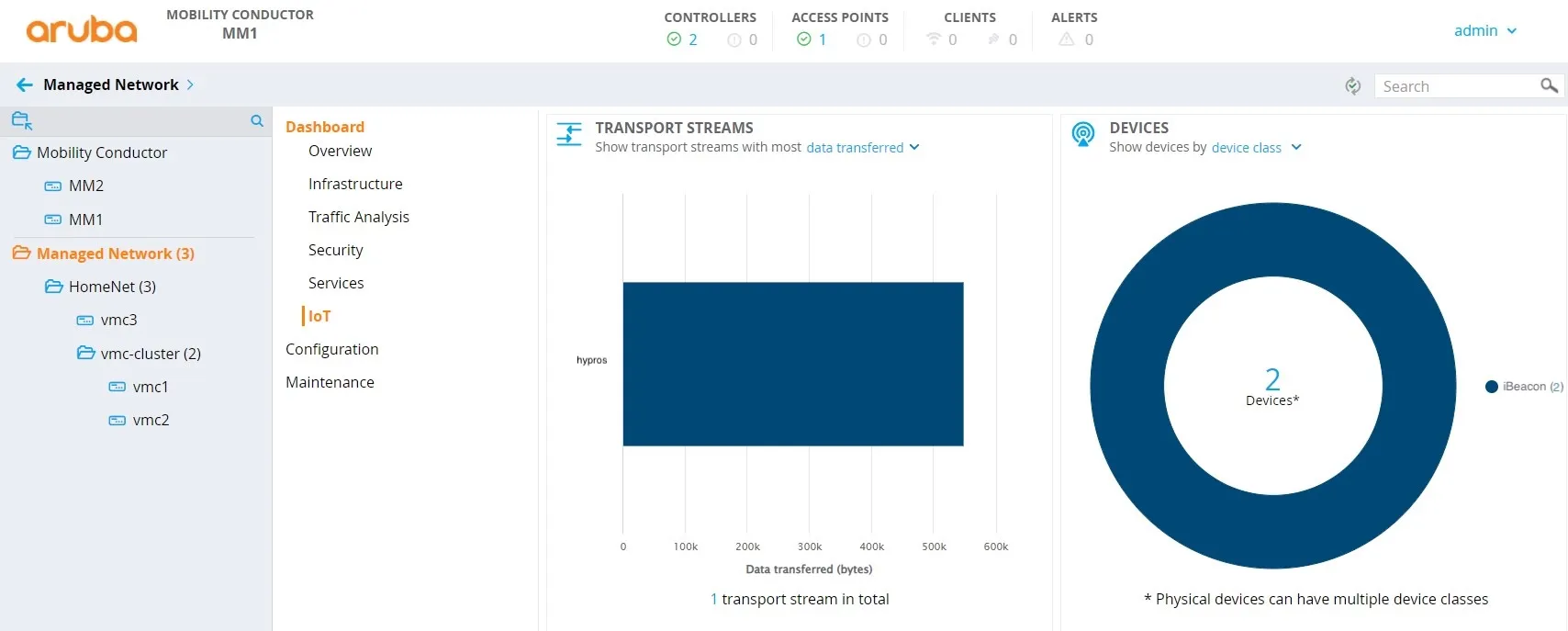
- Select the top level Managed Network in the configuration hierarchy. In the menu go to Dashboard > IoT to open the IoT dashboard page.
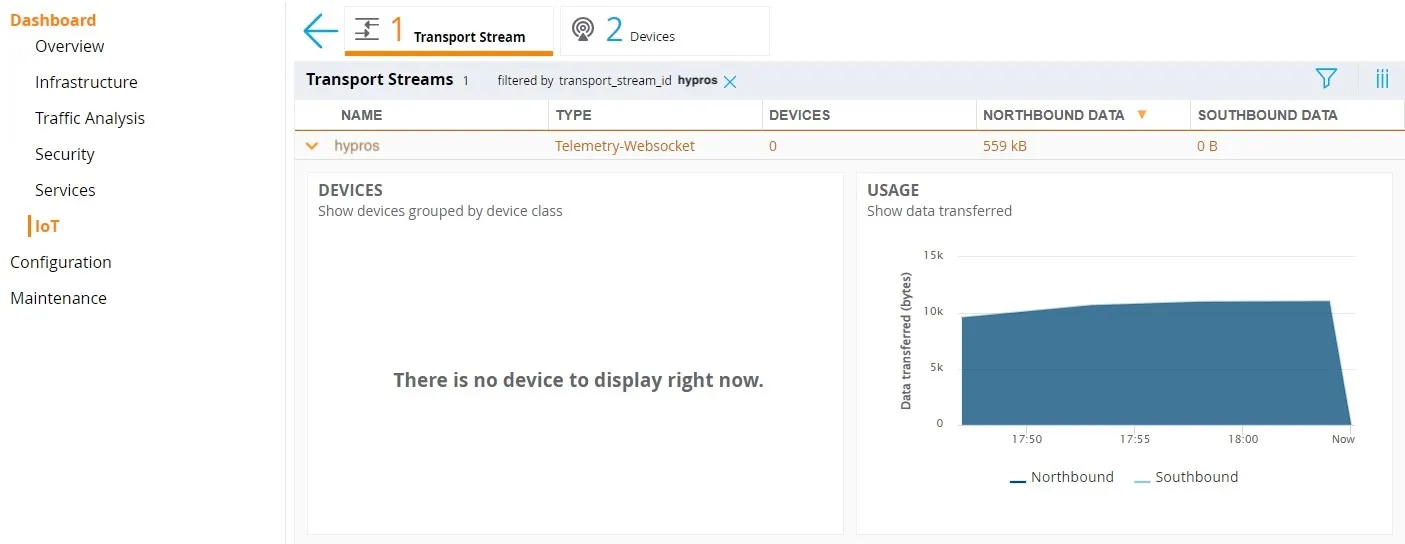
- Check if the configured IoT transport stream is listed and the data transferred shows non-zero values. Click on the specific transport stream in the dashboard to get details.
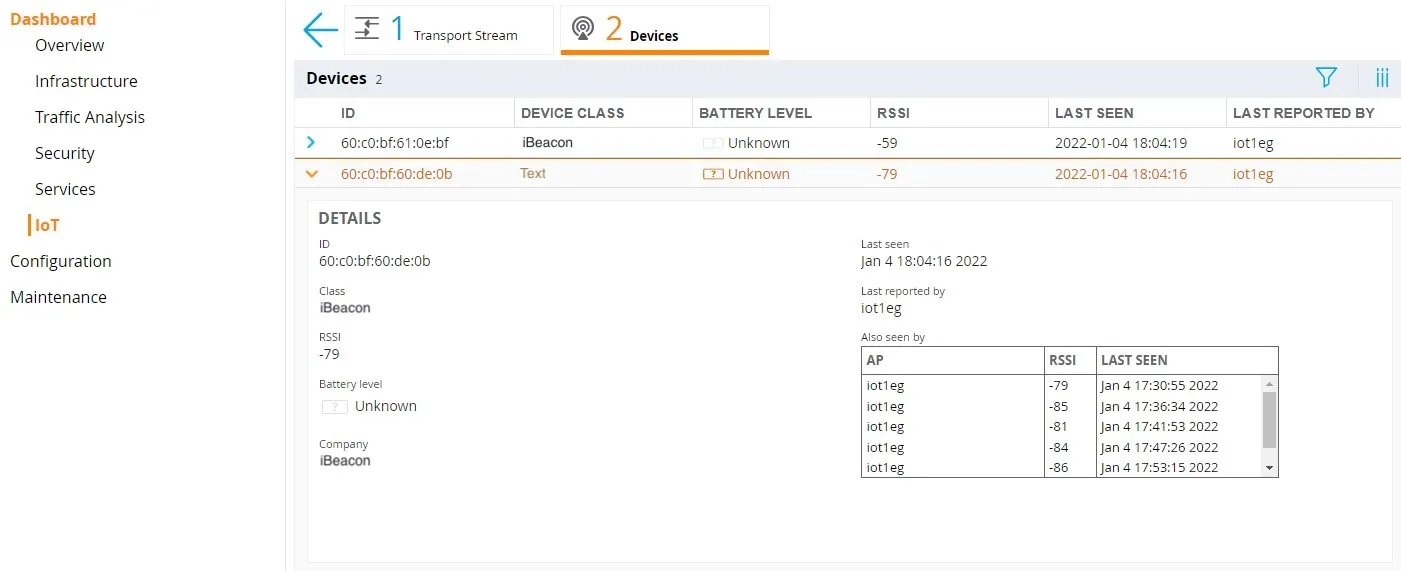
- Check if <deviceClass> devices are shown in the device list. Click on the Devices number in the dashboard to get details.
Mobility Controller CLI
Section titled “Mobility Controller CLI”To verify the configuration on HPE Aruba Networking Mobility Controllers, in standalone mode or if managed by a Mobility Conductor, connect to the HPE Aruba Networking Mobility Controller using SSH or the local console.
- Check if <deviceClass> BLE devices are seen by the APs BLE radio using the command show ap debug ble-table [ap-name|ip-addr|ip6-addr] generic:
ArubaOS#show ap debug ble-table ap-name <ap-name> generic

BLE Device Table [Generic]---------------------------MAC                Address Type  RSSI  Last Update  Device Class  Generic Filter  BT-SIG Company IDs---                ------------  ----  -----------  ------------  --------------  ------------------60:c0:bf:60:de:0b  Public        -82   I:3s         iBeacon       --              0x004C60:c0:bf:61:0e:bf  Public        -56   I:32s        iBeacon       --              0x004C
Generic BLE devices:2Total BLE devices:2
Note: Battery level for LS-BT1USB devices is indicated as USB.Note: Uptime is shown as Days hour:minute:second.Note: Last Update is time in seconds since last heard update.Note: Meas. Pow. is the averaged RSSI (in dBm) when the iBeacon is calibrated.Note: Tx_Power is shown in dBm in the APBs section for radios that support radio profile type 1. For all other APB radios, Tx_Power is a discrete level from 0-15.Status Flags:L:AP's local beacon; I:iBeacon; A:Beacon management capable         :H:High power beacon; T:Asset Tag Beacon; U:Upgrade of firmware pending         :u:Beacon management update receivedGeneric Filter:S:serviceUUIDFilter; C:companyIdentifierFilter         :M:macOuiFilter; L:localNameFilter
If no <deviceClass> devices show up in the APs BLE table, check the following things:
- Are <deviceClass> BLE devices in the range of the AP?
- Are the <deviceClass> devices switched on?
- Has the APs IoT radio been enabled with the settings shown in the configuration section?
- Has the device class <deviceClass> been selected in the IoT transport configuration as shown in the configuration section?
- Check if the IoT transport connection to the HYPROS backend has been established by using the following commands:
show ble_relay iot-profile
show ble_relay report
ArubaOS#show ble_relay iot-profile
ConfigID                                : 4
---------------------------Profile[hypros]---------------------------
serverURL                               : wss://<websocket-url>/<path>serverType                              : Telemetry WebsocketdeviceClassFilter                       : iBeacon, Eddystone, MinewreportingInterval                       : 600 secondauthentication-mode                     : noneaccessToken                             : <access-token>clientID                                : <client-id>rssiReporting                           : AverageenvironmentType                         : officebleDataForwarding                       : TRUEblePeriodicTelemetryDisable             : TRUEcompanyIdentifierFilter                 : 026Cinclude_ap_group                        : iot1,iot2Server Connection State--------------------------TransportContext                        : Connection EstablishedLast Data Update                        : 2022-01-04 18:23:30Last Send Time                          : 2022-01-04 18:23:33TransType                               : WebsocketArubaOS#show ble_relay report

---------------------------Profile[hypros]---------------------------
WebSocket Connect Status                : Connection EstablishedWebSocket Connection Established        : YesLocation Id                             : Not ConfiguredWebsocket Address                       : wss://<websocket-url>/<path>WebSocket Host                          : <websocket-url>WebSocket Path                          : <path>Vlan Interface                          : Not ConfiguredCurrent WebSocket Started at            : 2022-01-04 17:29:26Last Send Time                          : 2022-01-04 18:23:36Websocket Write Stats                   : 687 (106481B)Websocket Write WM                      : 0B (0)Websocket Read Stats                    : 0 (0B)
If the websocket connection status show a different status than Connection Established use the following command to check possible connection issues:
show ble-relay ws-log <profile>
- If the connection status shows Connection Established but the communication seems not to be working correctly, use the following command to check message processing through the websocket connection:
show ble_relay tag-report
Note: Repeat the show command multiple times to see if message counters increase. The Tag messages dropped should not increase and show only a low amount of dropped packets compared to incoming and processed messages, e.g. in the 0.x % range.
ArubaOS#show ble_relay tag-report

---------------------------Profile[hypros]---------------------------
Incoming Tag messages                   : 745Tag messages processed                  : 734Tag messages dropped                    : 11Tag messages WS queue success           : 734Tag messages WS queue unavailable       : 0Tag messages WS not connected           : 1Tag messages WS sent                    : 734Heartbeat messages WS sent              : 915
Common Causes of Connection Errors
Section titled “Common Causes of Connection Errors”- Trusted certificate chain for remote IoT server certificate not installed. Only applicable for secure connections (https://, wss://)
- Wrong authentication credentials for the remote IoT server connection (access token, username/password, clientId/secret)
- Domain name resolution not configured or not working, e.g. DNS server not reachable
- Connection blocked by firewall or other devices in the communication path
Note: Starting with ArubaOS 8.8 IoT server connections are automatically established from the Mobility Controller even if no messages need to be sent to the remote server e.g. because no BLE devices are seen by the HPE Aruba Networking AP, as long as at least one AP is connected to the controller with a configured IoT transport profile.